Hearing Test in Metairie, LA
If you have been asking people to repeat themselves, turning up the TV more than usual, or feeling left out in group conversations, a simple hearing test can tell you exactly what is going on and what to do about it.
At Crescent City Hearing Center on Veterans Memorial Blvd in Metairie, our hearing tests are painless, take about an hour, and give you a clear picture of your hearing health. Whether you leave with reassurance that your hearing is fine or with a plan to address hearing loss, you will walk away knowing.
We serve patients throughout Metairie, Kenner, Harahan, Jefferson Parish, and the Greater New Orleans area. Hearing tests are available in English and Spanish.

Why get a hearing aid test?
Hearing loss affects more than your ears. The World Health Organization projects that by 2050, one in ten people will have hearing loss severe enough to require intervention. Among adults over 65, the figure is already one in three.
The challenge is that hearing loss rarely announces itself. It creeps in gradually and because your brain adapts, you may not notice the sounds you have already lost. A professional hearing evaluation doesn’t just measure what you can hear. It identifies what you can’t, catches early-stage loss before it progresses, and gives you a documented baseline to compare against in the future.
Hearing aid tests:
- Catch hearing loss early
- Determine which hearing loss solutions are best for you
- Help you customize and program your hearing aids
5 Reasons to Have Your Hearing Tested
| Protect cognitive health | Untreated hearing loss is linked to faster cognitive decline, dementia, depression, and anxiety. Treating it early helps protect your brain. |
| Catch loss before it’s irreversible | Early detection allows for earlier intervention. The longer hearing loss goes untreated, the harder it becomes to adapt to hearing aids. |
| Establish a personal baseline | Even if your hearing is normal today, a baseline audiogram lets us track changes over time — especially important if you take ototoxic medications. |
| Identify causes, not just symptoms | A full evaluation can reveal whether your difficulty hearing is due to the inner ear, middle ear, nerve pathways, or earwax buildup — each requiring a different approach. |
| Check for medication side effects | Common medications including certain antibiotics, chemotherapy drugs, and even high-dose aspirin can damage hearing. A test can detect this early. |
How do I know if my hearing is bad, and when should I get tested?
Have you tried this super simple hearing aid test?
Ask your spouse, your kids, and your friends if they think you should get your hearing tested for hearing aid compatibility. Chances are, you don’t even need to ask. They’ve probably been telling you for years to see a specialist.
Yes, most of us are more stubborn than a mule and have put off acknowledging our hearing loss for years and years. But, whether you’re experiencing symptoms or not, hearing aid tests are proactive steps you can take to protect your hearing and detect problems early.
Specialists also recommend that you undergo at least one hearing aid test after reaching the age of 20 in order to establish a hearing baseline.
The frequency of these hearing aid tests can and should change if you begin noticing that you’re having hearing problems.
| Age / Situation | Recommended Frequency |
| Under 50, no symptoms | Every 3 years as a baseline check |
| 50–64 | Every 1–2 years — even without noticeable symptoms, since 1 in 4 adults with self-reported ‘excellent’ hearing actually has measurable loss |
| 65 and older | Annually — more than 30% of adults in this group have hearing loss |
| Any age: exposure to loud noise | After significant noise exposure or any sudden change in hearing |
| Any age: new medications | When starting medications known to affect hearing (ask your prescribing physician) |
| Any age: tinnitus present | Immediately — ringing or buzzing in the ears is often an early sign of hearing damage |
7 telltale signs you need a hearing aid test
Consider getting a hearing aid test if you:
- Begin to withdraw from social settings. For example, if you avoid going out with friends or co-workers.
- Have significant fatigue or memory problems, even if you’re getting enough sleep.
- Notice that voices sound muffled or distant when talking to other people.
- Have trouble understanding conversations because it feels as though letters or sounds keep dropping out–especially consonants.
- Need to consistently turn up the volume on your radio, mobile phone, or television.
- Ask others to speak up or repeat themselves frequently.
- Can’t understand speech in a crowd or in noisy situations.
If you suspect you are experiencing the symptoms of hearing loss, it’s important to undergo a hearing aid test as quickly as possible. The sooner you undergo testing, the faster you will be able to hear better.
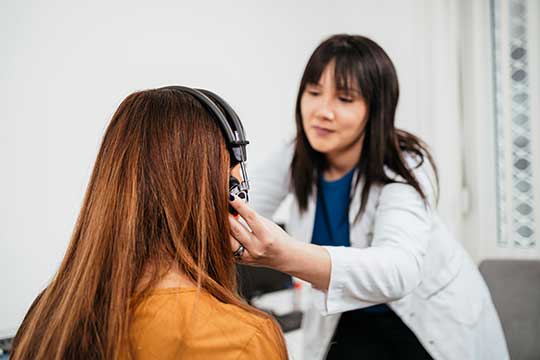
How can I test my hearing?
Every day you wake up is a test, and every day your family or friends talk to you is a test too. And it’d be easy to think everything is fine or almost perfect based on what you are hearing. Of course, the big problem is that there is a good chance you’ve already forgotten what you are missing. That happens to the best of us.
Which is why a professional hearing aid test is so important. You’ll discover what frequencies and types of sounds have gone missing and options for making them part of your life again, including hearing when your spouse or friend asks you to help with the dishes.
It’s easy to get started. Schedule a hearing aid test with us in Metairie to see if hearing aids will improve your ability to hear.
Our hearing aid test will check your ability to hear different frequencies. Most people will lose the ability to hear very low or high frequency sounds before there is any noticeable deterioration of the ability to detect mid-frequency noises.
All of this information is then displayed on an easy-to-read graph, called an audiogram. Effectively addressing your hearing loss depends on the ability to amplify the wavelengths you have difficulty hearing, making an audiogram an indispensable first step.
Types of hearing aid tests in Metairie, LA
There are many ways to test your hearing, including:
Pure-tone audiometry
During this test, your hearing aid specialist will instruct you to listen to tones at different frequencies and volumes.
Speech audiometry
Instead of listening to notes, you’ll listen to audible speech in a quiet room, in order to determine your speech reception threshold, or the lowest level you can hear a word and still understand it.
Cognivue: Cognitive Screening
Untreated hearing loss contributes to cognitive decline and dementia risk. Cognivue offers a five-minute, self-administered test that evaluates key cognitive functions including memory, visuospatial skills, and executive function, alongside reaction time and processing speed.
This screening serves as a vital tool in pinpointing cognitive decline stemming from factors such as depression, anxiety, and hearing loss, emphasizing the importance of proactive cognitive health management. Learn more about Cognivue.
Understanding Your Results
After your hearing test, your results are displayed on a chart called an audiogram. This is simply a map of your hearing across different pitches and volumes. Understanding what it shows helps you make informed decisions about your hearing health.
The horizontal axis represents frequency (pitch), measured in Hertz (Hz) from low pitches on the left to high pitches on the right. The vertical axis represents volume (loudness), measured in decibels (dB). Lower on the chart means softer sounds — so lower data points indicate better hearing ability for that frequency.
| Category | Threshold (dB) | What This Means |
| Normal Hearing | 0–25 dB | You can hear whispers and soft sounds without difficulty |
| Mild Hearing Loss | 26–40 dB | Soft speech is hard to catch, especially in background noise |
| Moderate Hearing Loss | 41–55 dB | Normal conversation at a distance or in noise is difficult |
| Moderately Severe | 56–70 dB | You need sounds significantly amplified to follow conversation |
| Severe Hearing Loss | 71–90 dB | Normal conversation without a hearing aid is very difficult |
| Profound Hearing Loss | 91+ dB | Even loud sounds may be inaudible without amplification |
Hearing loss is often uneven across frequencies. Many adults with age-related hearing loss hear low pitches well but struggle with high-frequency sounds — which is why consonants like S, F, TH, and SH are typically the first to become difficult to distinguish.
We will walk through your audiogram with you at the end of your appointment and explain exactly what each result means for your daily hearing experience.
What to Expect at Your Appointment
A hearing evaluation at Crescent City Hearing Center is comfortable, non-invasive, and takes approximately 45 to 60 minutes. Here is what your visit will look like:
- You arrive at our office on Veterans Memorial Blvd in Metairie. No referral is required. Free parking is available.
- We will ask about your hearing history, any symptoms you have noticed, medications you are taking, and any noise exposure in your work or recreational life.
- We will examine your ear canals using an otoscope to check for earwax blockage or other visible conditions that could affect your hearing.
- You will move to our sound-treated testing booth and put on headphones. The tests themselves are simple — you press a button or raise your hand when you hear each sound. There is nothing painful or uncomfortable.
- Depending on your results, we may also perform tympanometry and OAE testing.
- We will sit down with you to review your audiogram, explain what your results mean, and answer every question you have.
- If hearing loss is identified, we will discuss your options — including whether hearing aids are appropriate, which styles and technologies suit your lifestyle, and what the process of getting fitted looks like. There is never any pressure.
If you would like to bring a family member or close friend to your appointment, we encourage it. Hearing loss affects the people around you too, and having someone you trust in the room often leads to better outcomes.
Does Insurance Cover Hearing Tests in Louisiana?
Many insurance plans cover diagnostic hearing evaluations especially when ordered as part of a medical concern. Here is a general guide:
| Insurance Type | Typical Coverage |
| Medicare Part B | Covers diagnostic hearing tests when ordered by a physician for a medical reason. Does not cover routine hearing screenings or hearing aids. |
| Medicare Advantage (Part C) | Many plans include hearing benefits beyond Original Medicare — including screenings and sometimes hearing aid allowances. Coverage varies by plan. |
| Medicaid (Louisiana) | Covers hearing evaluations for eligible adults. Contact our office to confirm your specific plan. |
| Private / Employer Insurance | Coverage varies widely. We recommend calling your insurer to confirm in-network status. Our office can assist with this. |
| Veterans Benefits (VA) | Veterans with service-connected hearing conditions may qualify for covered evaluations and hearing aids through the VA. |
We are happy to help you understand your coverage before your appointment. Call or text us at 504-732-8092 and our team will review your benefits with you.
Frequently Asked Questions
Do I need a referral to get a hearing test?
No. You can schedule a hearing evaluation at Crescent City Hearing Center directly — no physician referral is required. However, if your insurance requires a referral for coverage, we will let you know in advance.
How long does a hearing test take?
A comprehensive hearing evaluation typically takes 45 to 60 minutes, including the pre-test consultation and the results review at the end of your appointment.
Is the hearing test painful?
Not at all. Hearing tests are completely non-invasive. You will wear headphones or sit in a quiet booth and respond to tones and words. The only sensation you may notice during tympanometry is a slight pressure change in the ear canal, which is entirely harmless.
What happens if the test shows I have hearing loss?
We will walk you through your audiogram results and explain what your level of hearing loss means for day-to-day life. If hearing aids are appropriate, we will discuss your options — including styles, technology levels, and pricing — without any pressure to make a decision on the day.
Will I leave with hearing aids on the same day?
Not usually. The hearing evaluation is the first step. If hearing aids are recommended, a separate fitting appointment is scheduled to customise and program devices to your specific audiogram.
Do you offer hearing tests in Spanish?
Yes. Crescent City Hearing Center has a Spanish-speaking team member available in the office. If you prefer to have your appointment conducted in Spanish, please let us know when you call. / Sí. Contamos con un miembro del equipo que habla español disponible en nuestra oficina.
What if I have ringing in my ears (tinnitus)?
Tinnitus is often an early sign of hearing damage and is always worth investigating. Your hearing evaluation will include an assessment of your tinnitus, and we will discuss management strategies and treatment options based on your results.
Is there a free hearing test available?
We offer an online hearing screener at the top of our website as a quick first step. However, an online screener cannot replace a clinical evaluation in a sound-treated booth. We encourage you to complete the online screener and then book a full in-office evaluation to get a complete picture.