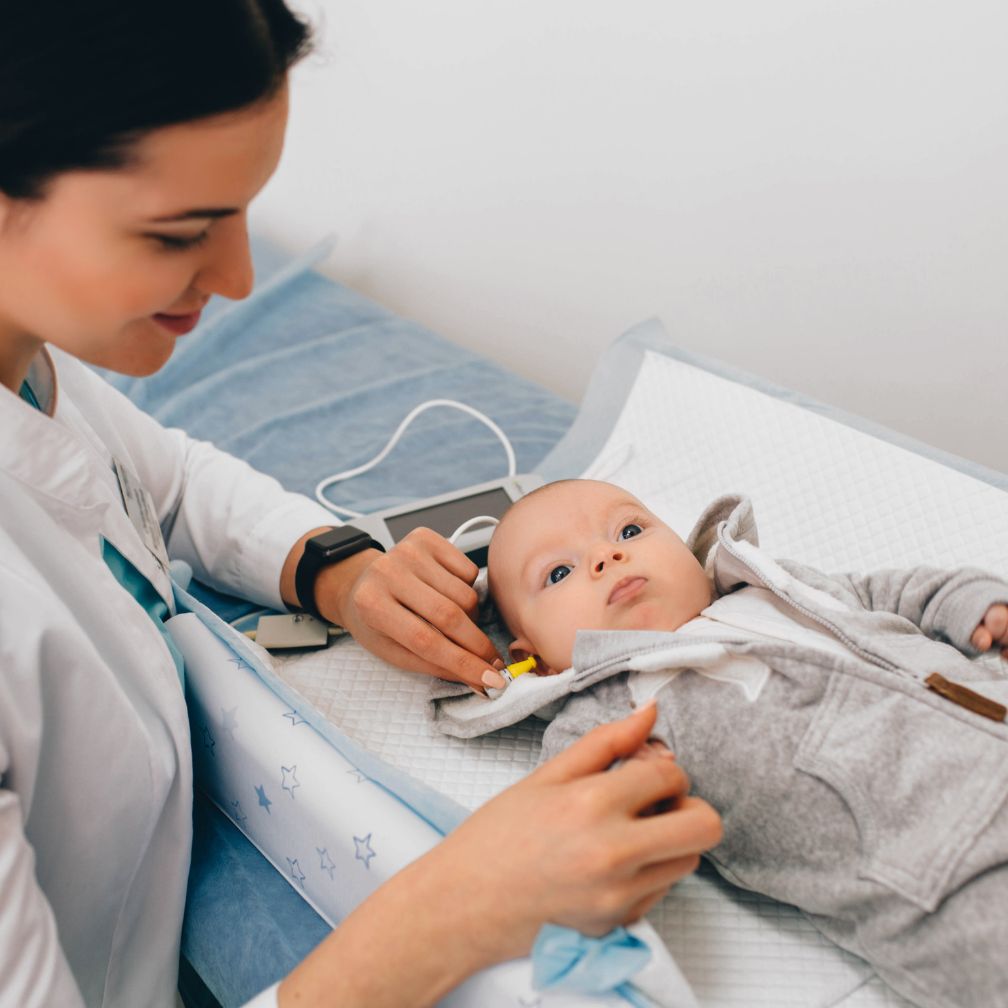
For newly minted parents, discovering that their infant has a hearing loss almost always feels terrifying and sad. Fortunately, the encouraging truth is that via early testing and professional support, young patients with hearing challenges can genuinely prosper wonderfully. Indeed, these children can build key verbal abilities, interactive skills, and solid bonds within their environment, leading to a vibrant, rewarding life!
Choosing modern hearing aids and surgical cochlear implants offers two effective treatment methods for supporting babies with hearing impairment. In the following segment, we detail their specific functions and explain how to determine the best choice for your infant.
Exploring Causes of Auditory Loss in Infants
Hearing deficits among babies routinely trace back to an array of medical influences, including:
- Known hereditary genetic markers (even absent any documented parental history)
- Active congenital infections such as cytomegalovirus (CMV) or rubella
- Severe delivery difficulties, such as acute oxygen deprivation or premature delivery
- Specific ototoxic pharmaceuticals administered in specialized neonatal units
Which action represents the highest priority? Prompt diagnostic confirmation. For this reason, infants across the United States undergo mandatory hearing screening preceding their departure from the facility. Board-certified pediatric audiologists maintain the standardized “1-3-6” care benchmark:
- Initial screening completed before 1 month of life
- Formal medical diagnosis confirmed before 90 days of life
- Prompt intervention (employing amplification units or structured therapy) launched prior to 6 months of life
Attaining these developmental checkpoints provides infants their highest potential for speech acquisition, language mastery, and brain development. Should you desire guidance on these early screenings, your trusted pediatrician stands ready to assist!
Deploying Hearing Aids for Newborns
In infants identified with mild to severe auditory loss, modern hearing aids frequently serve as the preferred starting point. These miniature, wearable instruments elevate acoustic volume, assisting babies in catching spoken words and environmental sounds more distinctly.
Custom infant-adapted hearing aids act as:
- Fully cleared and safe for babies merely weeks past delivery
- Designed with pliable, comfortable custom molds that adapt as the baby matures
- Outfitted with secure, tamper-resistant battery latches and specialized pediatric safety components
- Individually configured by a pediatric hearing professional to align with your baby’s exact hearing needs
As your baby grows, hearing aids will need to be adjusted regularly to guarantee physical comfort and optimal performance.
Cochlear Implants in Infant Auditory Care
Where a young infant shows severe to profound sensorineural hearing impairment while demonstrating limited success with standard amplification, clinicians often recommend a cochlear implant. In direct contrast to external acoustic hearing aids, modern cochlear implants:
- Mandate careful surgical placement directly into the auditory system
- Route directly past damaged cells within the inner ear apparatus
- Process incoming sound into refined electrical impulses that activate auditory nerve fibers directly
Pediatric cochlear implant systems remain:
- Formally cleared by the FDA for young children as young as 9 to 12 months
- Deeply effective when paired with early speech intervention and enthusiastic family care
- Sanctioned strictly following an exhaustive clinical assessment by a certified audiologist and otolaryngologist
Such a comprehensive process requires high-resolution imaging, detailed hearing tests, and setting realistic expectations for future communicative success.
Hearing Aids vs. Cochlear Implants: What’s the Difference?
- Mild to severe hearing loss: Hearing Aids; Severe to profound hearing impairment calls for Cochlear Implants
- Non-Invasive wearable application: Hearing Aids; Surgical insertion required: Cochlear Implants
- Traditional acoustic amplification: Hearing Aids; Direct electrical signal generation: Cochlear Implants
- Intervention starts in early infancy: Hearing Aids; Access starts at 9-12 months: Cochlear Implants
Hearing Aids vs. Cochlear Implants: Final Thoughts
Should your baby receive a formal hearing loss diagnosis, you can rely on excellent technological options and compassionate guidance. Thanks to collaboration with dedicated pediatric audiologists, countless infants successfully cultivate communication skills that mirror those of their age group.
Irrespective of whether your child receives fitting for hearing aids or surgery for cochlear devices, taking immediate action delivers permanent lifelong benefits.
Have you got specific questions concerning your newborn’s hearing abilities? Contact our staff today to obtain an exhaustive evaluation and custom-designed care plan.